Why You Keep Going Back to Old Patterns — And How to Finally Break the Cycle
Friday, January 23, 2026
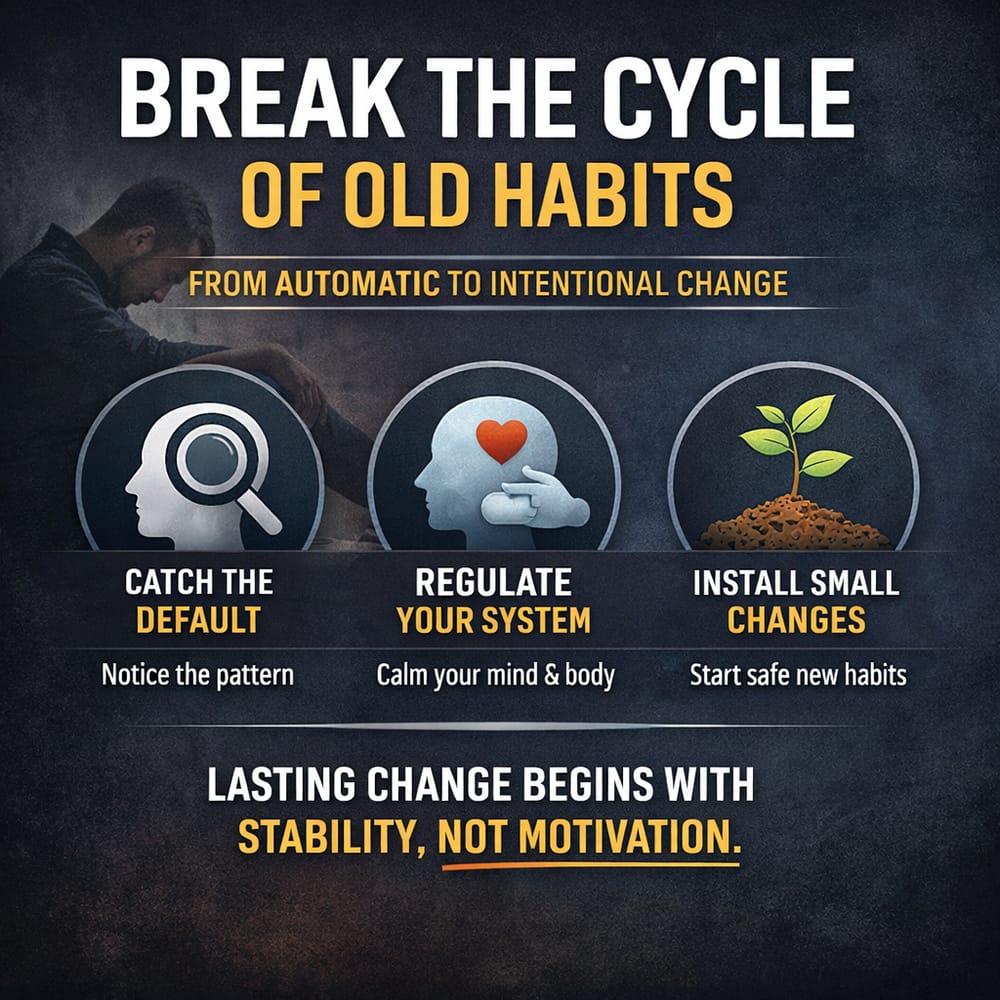

If you’ve ever said, “I’m not doing this again,” only to find yourself doing it again anyway, this is for you.
Because what keeps pulling you back isn’t weakness.
It isn’t laziness.
And it definitely isn’t a lack of discipline.
It’s your system doing exactly what it was trained to do.
Once you understand that, everything changes.
The Biggest Lie About Change
Most people believe change works like this:
- Decide
- Commit
- Push harder
Sounds logical. It’s also wrong.
That’s not how the human system operates—especially under stress.
When pressure rises, your brain doesn’t search for what’s best.
It searches for what’s familiar.
So when your energy drops, emotions spike, or stress hits, your system defaults. Not to sabotage you—but to protect you.
Your brain is wired for safety, not growth.
And familiar patterns—even unhealthy ones—feel safe because they once helped you survive, cope, or avoid pain.
Why You React Before You Think
Your brain is a predictive machine.
It runs on past data:
- What Worked Before?
- What avoided Pain?
- What required the least effort
Those answers become your defaults.
That’s why:
- You React Before Thinking
- You Pull Back When things Matter
- You Revert to Old Habits Under Pressure
This isn’t self-sabotage.
It’s automation.
You didn’t fail—you trained a system.
The good news?
Anything trained can be retrained.
Why Motivation Always Fails You
This is where most change attempts collapse.
We try to overwrite deeply ingrained defaults with motivation:
- "I'll be motivated to go to the gym"
- "I'll be motivated to write that book
- "This time I'll push harder"
Motivation feels powerful—until stress shows up.
Motivation is unreliable.
It disappears the moment you’re tired, overwhelmed, or emotionally charged.
And if the underlying system doesn’t change, the pattern repeats—no matter how badly you want different results.
Change does not start with intensity.
It starts with stability.
A Simple 3-Step Reprogramming Process
Real change begins when you stop fighting your system and start retraining it.
Here’s how.
Step 1: Catch the Default
You can’t change what you don’t notice.
When you feel yourself reacting, withdrawing, spiraling, or reaching for an old habit,
label it:
“This is my default.”
No judgment.
No shame.
Awareness creates a pause.
And the pause creates choice.
Step 2: Regulate Before You Redirect
You cannot reprogram a dysregulated system.
Before trying to “do better”:
• Slow your breath
• Ground your body
• Reduce the emotional charge
A calm system is a teachable system.
Regulation comes before redirection.
Step 3: Install a Small, Safe Alternative
Don’t aim for a life-changing habit.
Aim for something your system won’t resist.
Examples:
• Pause instead of reacting
• Take a short walk instead of withdrawing
• Write one sentence instead of avoiding the emotion
Small, repeatable actions feel safe—and safety allows change.
Each time you interrupt a default and respond differently,
your brain updates its prediction:
“Maybe this is safe.”
“Maybe we don’t need the old pattern anymore.”
That’s how new wiring forms.
Quietly.
Gradually.
Permanently.
You’re Not Stuck — You’re Untrained
If this resonates, that’s a good thing.
It means you’re not broken.
You’re not failing.
You simply have an untrained area of your system.
And retraining doesn’t require force—it requires the right order.
You don’t need to fight your system.
You need to retrain it.
And that process starts right here.