You Know What To Do. So Why Don’t You Do It?
Saturday, March 07, 2026

If You Have Every Said:
“I know what to do… so why don’t I just do it?”
This is for you.

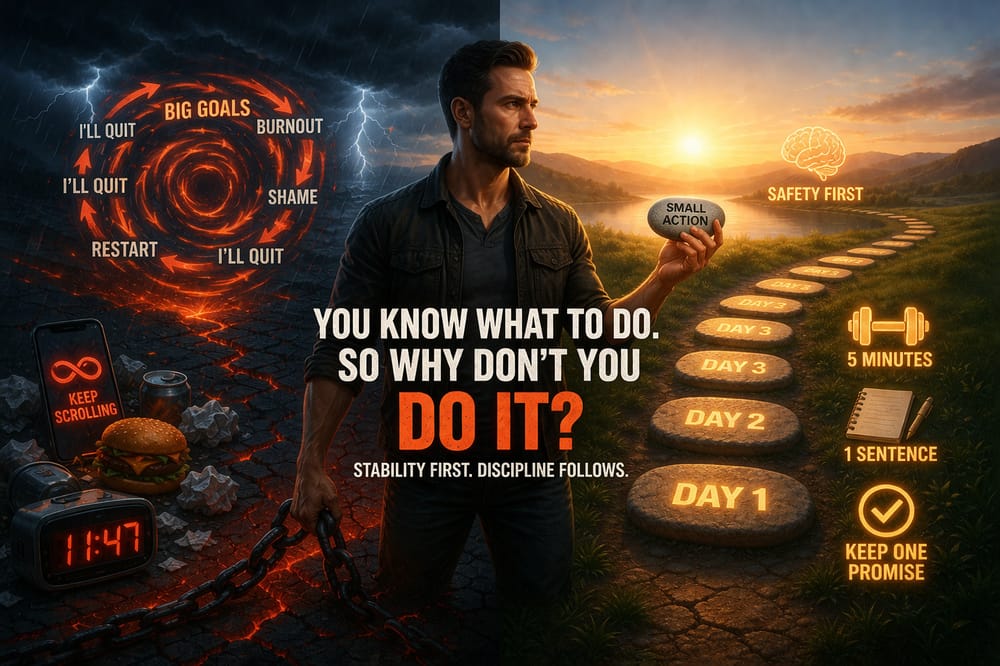
You know you should wake up earlier. - BUT YOU DON'T
You know you should eat better. - BUT YOU DON'T
You know you should stop scrolling. - BUT YOU DON'T
You know you should follow through. - BUT YOU DON'T
So you start questioning yourself.
Maybe I’m lazy.
Maybe I don’t have discipline.
Maybe something’s wrong with me.
Let’s correct that right now.
There is nothing wrong with you.
You’re not broken.
You’re running a system you don’t understand yet .
And once you understand the system, everything makes sense.
The Real Problem Is Not Motivation
Most driven men assume this is a motivation problem.
It isn’t.
It’s a safety problem.
Your brain cares more about safety than success .
Even if your goal would improve your life.
Even if the change is positive.
If it feels uncertain, uncomfortable, or risky, your brain categorizes it as danger.
And danger triggers avoidance.
Not because you’re weak.
Because you’re human.
Under the Stability Under Pressure framework, this falls under Regulation.
When stress rises, your nervous system shifts into protection mode. In protection mode, comfort wins. Growth loses.
Not permanently. Just predictably.
The Pattern Loop That Keeps You Stuck
Your brain works through pattern repetition .
Whatever you repeatedly do becomes normal.
Whatever becomes normal feels safe.
Whatever feels safe gets repeated.
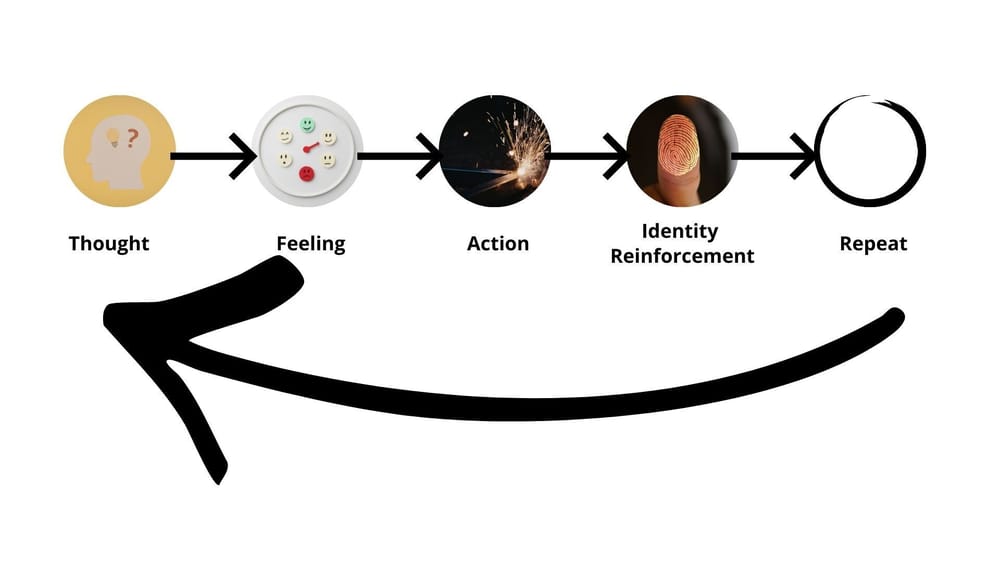
Now layer this into your identity loop:
EXAMPLE:
- THOUGHT: "I never stick with things"
- FEELING: Doubt
- ACTION: Hestitation
- RESULT: You Don't Follow Through
- IDENTITY REINFORCEMENT: "See, I don't stick with things"
You didn’t sabotage yourself.
You reinforced a pattern.
And your brain loves patterns.
That is not a discipline failure. That is a feedback loop.
Why Willpower Keeps Failing You
Willpower only works when you are calm, rested, and not under pressure .
Real life does not operate in those conditions.
You get stressed.
You get tired.
You get overwhelmed.
When stress goes up, willpower goes down .
Because stress activates survival mode. And survival mode seeks comfort, not long term growth .
This is why driven men start strong, then quit when life gets heavy.
It’s not lack of discipline.
It’s a nervous system overload .
You built a habit larger than your system could handle.
Under the SUP doctrine, this is a Capacity miscalculation.
You attempted to scale behavior before stabilizing the system.
That always collapses.
The Restart Cycle That Destroys Self Trust
Here is the classic cycle:
- Big Goal
- Big Push
- Burnout
- Quit
- Shame
- Restart New Goal
- Repeat
Every time you restart, self trust erodes.
And without self trust, confidence cannot stabilize.
This is why motivation based change does not last.
It skips regulation.
It ignores calibration.
It overwhelms capacity.
The Shift That Actually Works
Go smaller.
Not bigger.
Smaller
Small enough that it feels almost too easy.
Small enough you can do it on your worst day, not your best day .
Your worst day reveals your real system.
If you want to work out, do five minutes.
If you want to journal, write one sentence.
If you want discipline, keep one promise .
Why does this work?
Because small actions feel safe .
When something feels safe, your brain allows it.
When your brain allows it, you repeat it.
When you repeat it, your identity shifts .
Identity does not come first.
Behavior does.
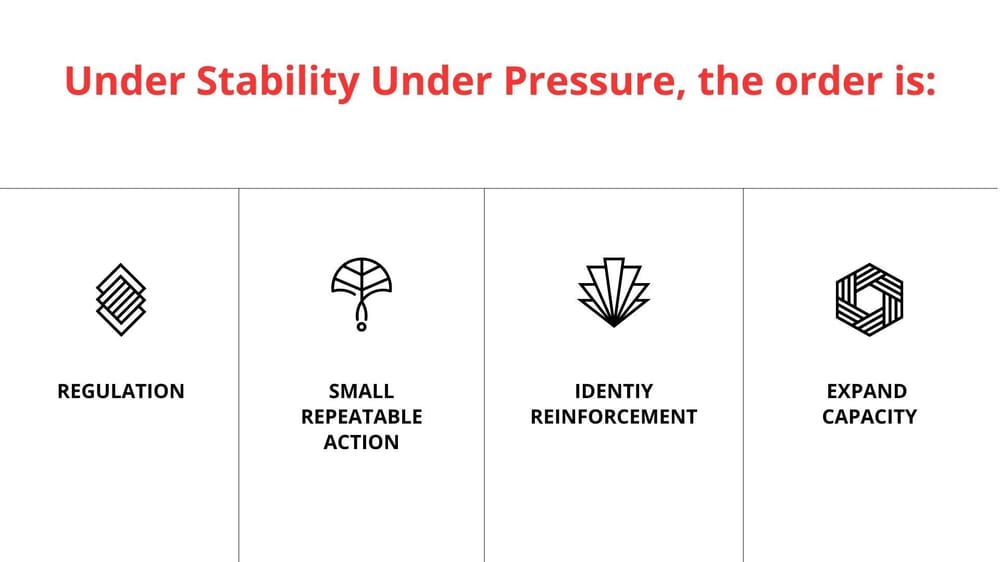
That order holds under stress.
Discipline Is Not Force. It Is Evidence.
Discipline is not forcing yourself.
It is reinforcing identity through proof .
Your brain believes evidence more than words .
If you repeatedly quit, your brain builds the identity of someone who quits .
If you repeatedly keep promises, your brain builds the identity of someone who follows through .
Every kept promise is evidence.
Evidence builds trust.
Trust builds confidence.
Confidence makes action easier .
Proof first.
Confidence second.
That is structural discipline.
The 7 Day Reset – Exercise
If you want to break the cycle, here is the reset:
1. Notice one recurring thought.
- "I CAN'T stay consistent"
- "I ALWAYS mess this up"
- "I'm NOT Disciplined"
2. Label it.
“That’s just a thought.”
Not truth. Just a thought .
3. Choose one tiny action that contradicts it.
So small you cannot fail .
Do it daily for seven days.
No overhaul.
No dramatic reset.
Just small proof .
Small proof rewrites the system.
Your brain craves predictability .
When you show up consistently in small ways, your brain relaxes.
It stops fighting you.
It starts trusting you .
Confidence rises not from hype, but from evidence .
That works under stress.
That works when tired.
That works in real life .
Stability First. Identity Second.
You have been trying to force behavior without stabilizing the system underneath it .
Big goals first. Identity later.
That order collapses .
The correct order:
Stability first.
Small repeatable action.
Identity reinforcement.
That is how change sticks .
Not hype.
Not pressure.
Not shame.
STRUCTURE!!!
WATCH THIS VIDEO NEXT