How to Rebuild Self-Trust When You’ve Failed Yourself
Friday, February 13, 2026

Let’s start with something we rarely admit out loud:
“I’ve failed myself.”
Not because I’m lazy. Not because I lack discipline. But because I’ve made promises to myself that I didn’t keep. I started things with good intentions… and stopped. I tried harder, pushed more, and ended up stuck in the same cycle.
And if you’ve been there too, I want you to know:
It’s not a motivation problem.
It’s not a willpower issue.
It’s a nervous system issue.
Your system learned something from all those broken promises—and it wasn’t that you’re weak. It was that effort started to feel unsafe.
The Field Story: How Self-Trust Quietly Breaks
There was once a man who made a simple promise:
Each morning, he’d walk to the edge of his field and stand there for five minutes. Nothing big. No grand gesture. Just five minutes.
Day one: he walked halfway and turned around.
Day two: he didn’t even leave the porch.
Day three: no promise at all.
Weeks passed. The field never changed. But every time he thought about walking toward it, his chest tightened—not because the walk was hard, but because his body remembered all the times he didn’t follow through.
The result?
His nervous system stopped believing his own words.
Not because of failure but because of repeated disappointment.
Why Trying Harder Makes It Worse
We’ve been sold a lie: that more pressure will fix us.
That if we just believe in ourselves, or install the right discipline, everything will click.
But belief doesn’t create trust. Predictability does.
Your nervous system isn’t judging your goals.
It’s scanning for one thing: “Is this safe?”
When effort feels like pressure, pressure becomes threat.
And your system does what it was designed to do -it pulls away.
This is why you:
- Procrastinate on things you care about
- Quit before you start
- Numb out instead of taking action
Not because you're broken. But because your system has learned that trying = tension = crash.
What Self-Trust Really Is
Self-trust isn’t confidence.
It’s not motivation.
It’s not hustle.
Self-trust is your nervous system believing that effort won’t overwhelm you.
So let’s go back to the man in the field.
Eventually, he stopped making promises—and started with tiny actions:
• One day, he took three slow breaths.
• Another, he wrote one sentence.
• Another, he walked to the end of his driveway and back.
Nothing impressive. No fireworks. But slowly, his system learned:
“Effort is safe. Follow-through doesn’t mean collapse. I can handle what I start.”
And from that safety, self-trust returned.
The Real Reason You Struggle with Consistency
It’s not inconsistency that’s the issue, it’s that you stop when stress shows up.
Here’s the pattern most people miss:
- You start when life is calm.
- Stress Hits
- You Stop
- You Blame Yourself
But it wasn’t a discipline failure.
It was a stress tolerance one.
Your system didn’t malfunction, it protected you.
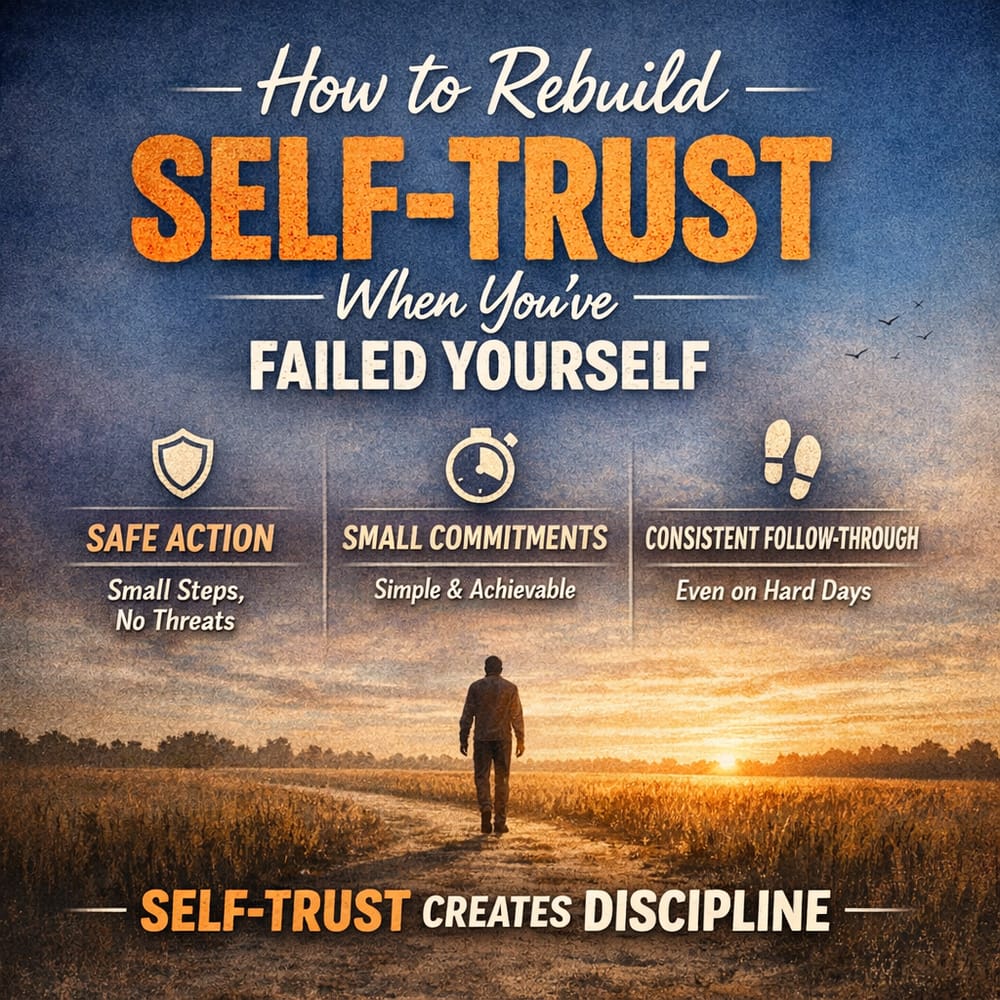
The 3 Conditions That Rebuild Self-Trust
You don’t rebuild self-trust with hype.
You don’t need to go “all in.”
You need to rebuild the foundation.
Here’s how:
1. The action must feel safe.
- If your body hears threat, it won’t follow through.
2. The commitment must be small enough to complete while stressed.
- Five minutes. One breath. One rep.
3. Follow-through must be consistent.
- Especially on your worst days.
Because self-trust isn’t built on your best days.
It’s built on the ones where you didn’t want to show up… but you did anyway.
Real Example: From Pressure to Progress
Old path:
“I’m working out five days a week.” (System hears pressure. One missed day = trust broken.)
New path:
“I’ll move for five minutes.” (Feels doable. Completed. Trust grows.)
The irony? Once trust returns… effort expands on its own. You don’t need to hype yourself up. Action just becomes natural again.
Self-Trust Leads to Confidence and Discipline
Here’s the chain most people reverse:
• They try to build discipline first.
• But without self-trust, discipline feels like punishment.
• And the system resists.
But when self-trust is restored:
• You stop overthinking.
• You stop negotiating with yourself.
• You act without needing a pep talk.
That’s when real confidence begins.
Confidence says: “I believe I can.”
Self-trust says: “I know I’ll follow through.”
And that difference? It changes everything.
🎥 If this resonated, your next step is to watch the follow-up video:
“How to Build Self-Discipline (Why Willpower Fails and Confidence Follows).”
Because the truth is: discipline doesn’t create self-trust.
Self-trust creates discipline.
And once that’s in place—everything starts working again.