Why You’re Overthinking — And Why It’s Not Weakness
Friday, March 13, 2026
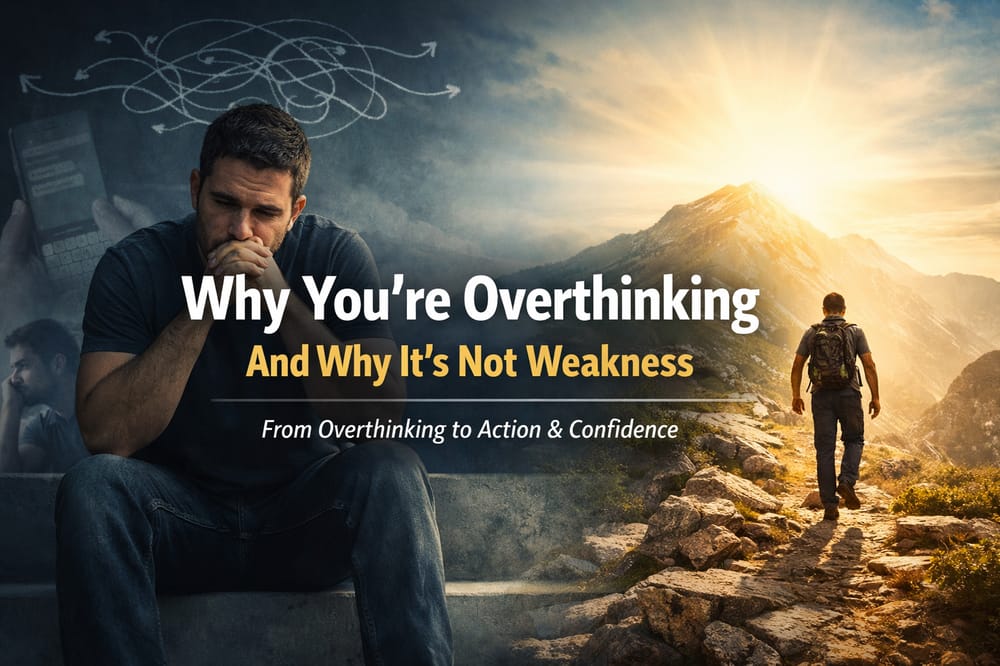
If you’ve ever thought:
Why can’t I just decide?
Why do I replay conversations 20 times?
Why do I stare at my phone trying to craft the perfect message?
Why do I delay decisions for weeks even when I know what to do?
You are not weak.
You are not broken.
And you are definitely not “just wired this way.”
You are overthinking because your brain is trying to protect you.
Once you understand that, everything changes.
Overthinking Is Not a Thinking Problem
Most driven men assume overthinking means:
• I need more clarity
• I care too much
• I need better discipline
• I’m just cautious
None of that is accurate.
Overthinking is not a thinking problem.
It is a safety problem.
Your brain has one primary job: keep you safe.
Not confident.
Not productive.
Not impressive.
Safe.
So when you’re about to:
• Send the message
• Speak up
• Make the decision
• Start the thing
• Take the risk
Your brain asks one question:
Is this safe?
If the answer feels uncertain, your brain slows you down.
How?
By thinking more.
Because thinking feels safer than acting.
If you think long enough, maybe you won’t mess up.
If you analyze long enough, maybe you won’t fail.
If you prepare long enough, maybe you won’t regret it.
So the loop begins.
Thought.
Doubt.
More thinking.
More doubt.
Freeze.
Not because you lack discipline.
Because your brain is protecting you from risk.
Why “Just Decide” Never Works
People love to say:
Stop overthinking.
Just decide.
Be confident.
That advice sounds strong.
But it doesn’t solve the real issue.
Telling someone to “just decide” when their brain feels unsafe is like telling a child to “just stop being scared.”
It does not remove fear.
If your nervous system perceives uncertainty as danger, forcing action feels threatening.
So what happens?
More doubt.
More hesitation.
More scenarios.
Because the real issue is not the decision.
It is trust.
You don’t fully trust yourself to handle the outcome.
And when trust is low, thinking increases.
Thinking Does Not Build Trust
This is the part most people miss.
Thinking does not build trust.
Action builds trust.
You can mentally rehearse something 100 times.
You can promise yourself you’ll stop overthinking.
Your brain does not care about promises.
It cares about proof.
Confidence is not a feeling you wait for.
It is a memory your brain builds.
Every time you act and survive, your brain stores data:
We survived.
That wasn’t as dangerous as we thought.
We can handle this.
That stored proof becomes confidence.
Not hype.
Not positive thinking.
Stored proof.
The Small Move That Stops Overthinking
If overthinking is a safety issue, the solution is not more thinking.
The solution is safe action.
Not bold action.
Not extreme action.
Not fearless action.
Small action.
Because small action feels safer than big action.
And when something feels safer, your brain allows it.
Here’s what that looks like in real life:
Overthinking sending a message?
Send one clear sentence. Not the perfect paragraph.
Overthinking working out?
Do five push-ups. Not a 12-week program.
Overthinking starting something new?
Take one small step today. Not a full-year strategy.
Small movement interrupts the loop.
Why?
Because movement gives your brain new data.
And new data builds trust.
Clarity Comes After Action
Many people say:
I just want to feel sure first.
I want clarity before I move.
Here’s the truth:
Clarity does not come before action.
Clarity comes after action.
You do not think your way into clarity.
You move your way into clarity.
You can study swimming for years.
But you only learn balance once you get in the water.
Movement creates clarity.
Stillness creates more thinking.
The Three-Step Overthinking Reset
If you want something practical, here is a simple three-step reset you can use immediately.
1. Catch It
When you notice the loop starting, say:
I’m overthinking.
Naming it reduces its power.
2. Shrink It
Ask yourself:
What is the smallest possible next step?
Not the final step.
Not the big outcome.
The smallest next movement.
3. Move Immediately
Take that step before your brain starts another argument.
Then stop.
Let your brain process the outcome.
No personality overhaul.
No dramatic risk.
Just movement.
Why This Matters for Driven Men
Overthinking feels especially frustrating when you are capable.
You know what to do.
You have the skills.
You have handled hard things before.
Which makes the mental freeze even more irritating.
But now you understand something important:
It is not a knowledge problem.
It is a trust problem.
And trust is not built through mental debate.
It is built through small, safe action repeated consistently.
You are not broken.
Your brain is just trying to protect familiarity.
Safety grows through movement.
Confidence grows through stored proof.
Clarity grows through action.
So next time the loop starts, do not solve everything.
Do not force clarity.
Take the smallest next step.
Let clarity catch up later.
That is how you retrain your system.
And once you understand that, overthinking stops feeling personal.
It starts feeling predictable.
And predictable patterns can be changed.
With movement.