You Can’t Think Your Way Out of Anxiety — Here’s Why
Friday, January 16, 2026
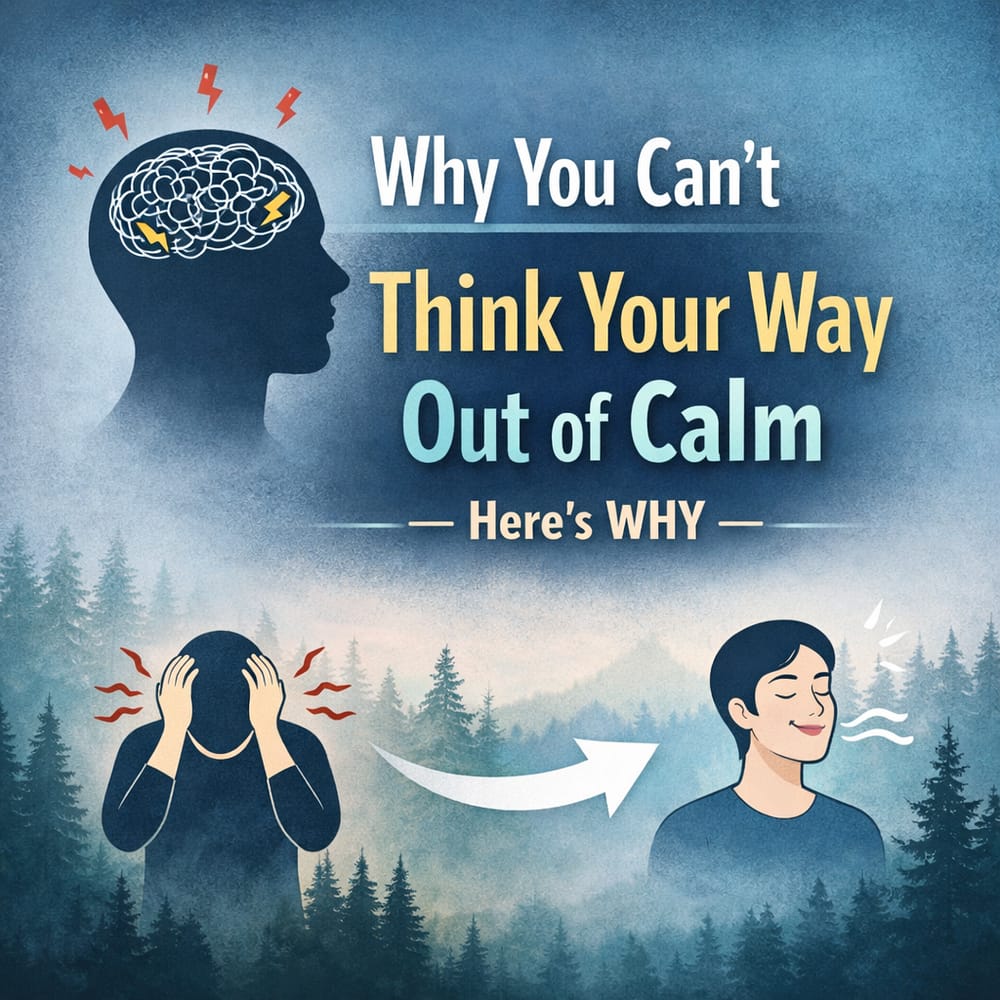

If you feel anxious, overwhelmed, scattered, or stuck in your head, this is not a mindset problem.
It’s also not a lack of positivity, motivation, or self-awareness.
Most people struggling with anxiety aren’t dealing with weak thinking — they’re dealing with a nervous system that has been stuck in survival mode for far too long. And until that system feels safe, no amount of journaling, affirmations, or “just calm down” advice is going to work.
This is where most approaches miss the mark.
The Real Problem With Trying to “Think Calm”
Here’s what usually happens:
You try to reason your way out of anxiety.
You tell yourself to relax.
You try to reframe the thought.
You search for clarity, insight, or motivation.
But your body is still signaling danger.
When the nervous system is dysregulated, it does not respond to logic. It responds to safety. That’s why you can intellectually understand what’s happening and still feel overwhelmed, tense, and mentally loud.
Overthinking isn’t a flaw — it’s a protective response. Your system is doing exactly what it was trained to do: stay alert, scan for threat, and keep you prepared.
The problem isn’t you.
The problem is that your system never learned how to stand down.
Why Internal Chaos Feels So Hard to Escape
Internal chaos usually shows up as sympathetic activation — the body’s “on” switch being stuck in the up position. It often looks like:
• Racing or looping thoughts
• Tight chest or shallow breathing
• Emotional reactivity
• Difficulty resting, even when exhausted
• Feeling wired but depleted
This happens because the body adapts to pressure. Over time, it learns that constant alertness is normal. But without intentional training, it never learns how to return to calm.
You cannot slow a system that has never been taught how.
That’s why real change has to happen from the inside out.
A Simple Three-Step Nervous System Reset
This is not a hype routine.
It’s not emotional excavation.
And it’s not something you force during chaos.
You practice this in calm moments so your system knows what to do when pressure shows up.
Step 1: Change the Body First
Send immediate safety signals.
• Drop your shoulders
• Unclench your jaw
• Let your tongue rest on the floor of your mouth
This is not a mindset trick. These physical cues communicate safety directly to the nervous system.
Step 2: Slow the Exhale
- Inhale normally through your nose.
- Exhale slowly through your mouth — longer than the inhale.
- Repeat for three to five rounds.
This is tactical breathing. It acts like a brake pedal for your nervous system, lowering heart rate and signaling that the threat has passed.
Step 3: Anchor the Present Moment
Internally say:
“I am allowed to be here. Nothing is required of me right now. This moment is safe.”
You’re not convincing yourself of anything. You’re orienting your system to reality.
If someone calmly told you that you were safe during a stressful moment, your body would respond. This does the same thing — from the inside.
Why Calm Comes Before Confidence
Calm is not a personality trait.
It’s not a reward for trying harder.
And it’s not something you earn through discipline.
A regulated nervous system is the foundation for confidence, consistency, and identity change. Without it, progress collapses under pressure.
When your system feels safe:
• Thoughts naturally quiet
• Emotions stabilize
• Behavior becomes intentional instead of reactive
• Identity change actually sticks
The goal is not to force calm — it’s to send safety signals consistently enough that calm becomes your baseline.
What to Carry Into This Week
Do less forcing.
Send more safety signals.
Start where change actually begins — with the nervous system.
When calm is the foundation, everything else has something solid to stand on.